Smartphones are now an integral part of young people’s daily lives, offering opportunities for communication, learning and access to information. However, their constant presence in schools has also raised concerns about concentration, emotional wellbeing and the quality of social interactions among students.
Across Europe, schools are exploring different strategies to create healthier digital environments. These approaches range from digital education and agreements with families to practical solutions that reduce distractions during learning time.
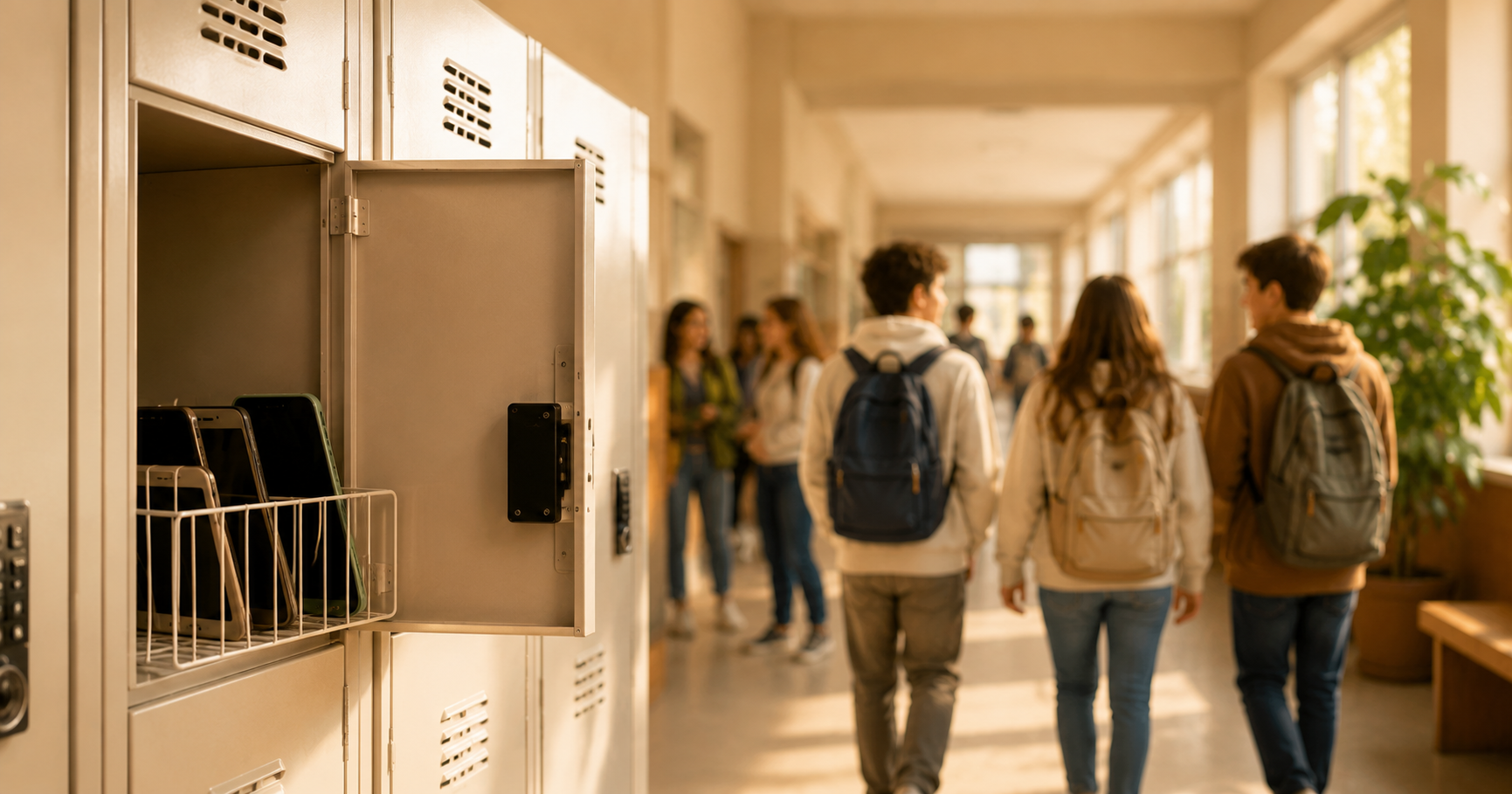
One example comes from Colegio Ferroviario in Córdoba, Spain, where mobile phone lockers have been introduced as part of a wider effort to promote student wellbeing and create more focused learning spaces.
In the case of Colegio Ferroviario, the school management has installed specific lockers across all four years of Compulsory Secondary Education (ESO). The system requires students to store their mobile phones in classroom lockers at the beginning of the school day, with devices safely stored until they are returned at home time. According to the school management, this measure has contributed to improving students’ attention during lessons and reducing unjustified interruptions. Students have also recognised the positive impact of the initiative, highlighting improvements in the school climate and the benefits of reducing mobile phone use during school hours.
Support from families has been a key factor in implementing this storage protocol, which remains voluntary but has received broad acceptance from the school community. The Parents’ Association (PTA) of Colegio Ferroviario has identified the management of screen time as one of the main concerns among families and has expressed its support for measures promoting healthier digital habits among students.
To reinforce this policy, the school’s PTA has collaborated with experts to deliver technical training on risks and prevention. These workshops are aimed at families and focus on managing digital hygiene in childhood and adolescence. The training aims to ensure that the restrictions applied in the classroom are supported by consistent education at home, addressing the impact of technology on the neurological development of minors.
The use of security lockers has also been linked to positive effects on mental health and the school climate in Córdoba’s schools. Initial observations suggest a reduction in social anxiety and in the urge to constantly check social media, while encouraging more direct interactions among students.
This observation finds solid backing in recent European research. For example, Abrahamsson’s (2024) comprehensive Norwegian study showed that restricting smartphones in secondary schools led to adolescents, especially girls, showing less need for clinical consultations for psychological symptoms. Likewise, both in Norway and in research on regional policies in Spain (Beneito and Vicente-Chirivella, 2022), the absence of devices significantly reduced the incidence of bullying.
Internally, there has also been a noticeable decrease in repeated visits to the toilet, which were often used as an excuse to secretly access phones during lesson time.
This wave of rationalisation is spreading across the province, where various cooperative and state schools are assessing the technical feasibility of such infrastructure. Schools that have adopted physical storage testify to a recovery of social spaces during break times, encouraging direct interpersonal contact rather than screen-mediated interaction. The measure is shaping up as a logistical solution to balance students’ safety outside school with academic rigour inside.
Following the results achieved in Secondary, the Colegio Ferroviario is considering extending the use of lockers to Years 5 and 6 of Primary Education. This expansion responds to the drop in the age at which children get their first smartphone, placing prevention in the pre-adolescent stages. The goal is to consolidate habits of digital disconnection in an early and supervised manner before they move on to higher educational levels.
Colegio Ferroviario is run by the Cooperativa Alhucema, made up of education professionals who apply autonomous management models in their facilities. The institution integrates digital wellbeing and health programmes as a fundamental part of its pedagogical and organisational project.
The cooperative plans to track academic achievement indicators to assess the long-term impact of these technological control measures on the pupils. Science anticipates a positive impact: Beland and Murphy’s (2016) pioneering study in the UK showed that banning mobile phones not only improves grades but also helps close the educational attainment gap, almost exclusively benefiting lower-achieving pupils.
In the Spanish context, research links this type of regulation to progress equivalent to almost a full academic year in subjects such as maths and science. Even studies that found a neutral effect on grades, such as the Swedish case of Kessel, Hardardottir and Tyrefors (2020), warn that effectiveness depends on strict compliance, confirming the usefulness of physical mechanisms like lockers over theoretical bans that are difficult to enforce.
Resources
Abrahamsson, S. (2024). Smartphone Bans, Student Outcomes and Mental Health. https://papers.ssrn.com/sol3/papers.cfm?abstract_id=4735240&__cf_chl_f_tk=7VRrazVu6HspWARqKJMu0EWWVuKNs7g2AWFRGjhgsmo-1783353848-1.0.1.1-n2Eg9.rxzUFlKbHBYomm95cDoT15NmTih321kueNFgQ
Beland, L.-P., & Murphy, R. (2016). Ill Communication: Technology, Distraction & Student Performance. Centre for Economic Performance, London School of Economics. https://www.sciencedirect.com/science/article/abs/pii/S0927537116300136
Beneito, P., & Vicente-Chirivella, Ó. (2022). Banning Mobile Phones in Schools: Evidence from Regional Policies in Spain. https://www.emerald.com/aea/article/30/90/153/59588/Banning-mobile-phones-in-schools-evidence-from
Kessel, D., Hardardottir, H. L., & Tyrefors, B. (2020). The Impact of Banning Mobile Phones in Swedish Secondary Schools. https://www.sciencedirect.com/science/article/abs/pii/S0272775719303966